The Hidden Cost of Not Automating: What's Really Bleeding Your Business Dry
Muchiri Mwangi
AI Automation Specialist
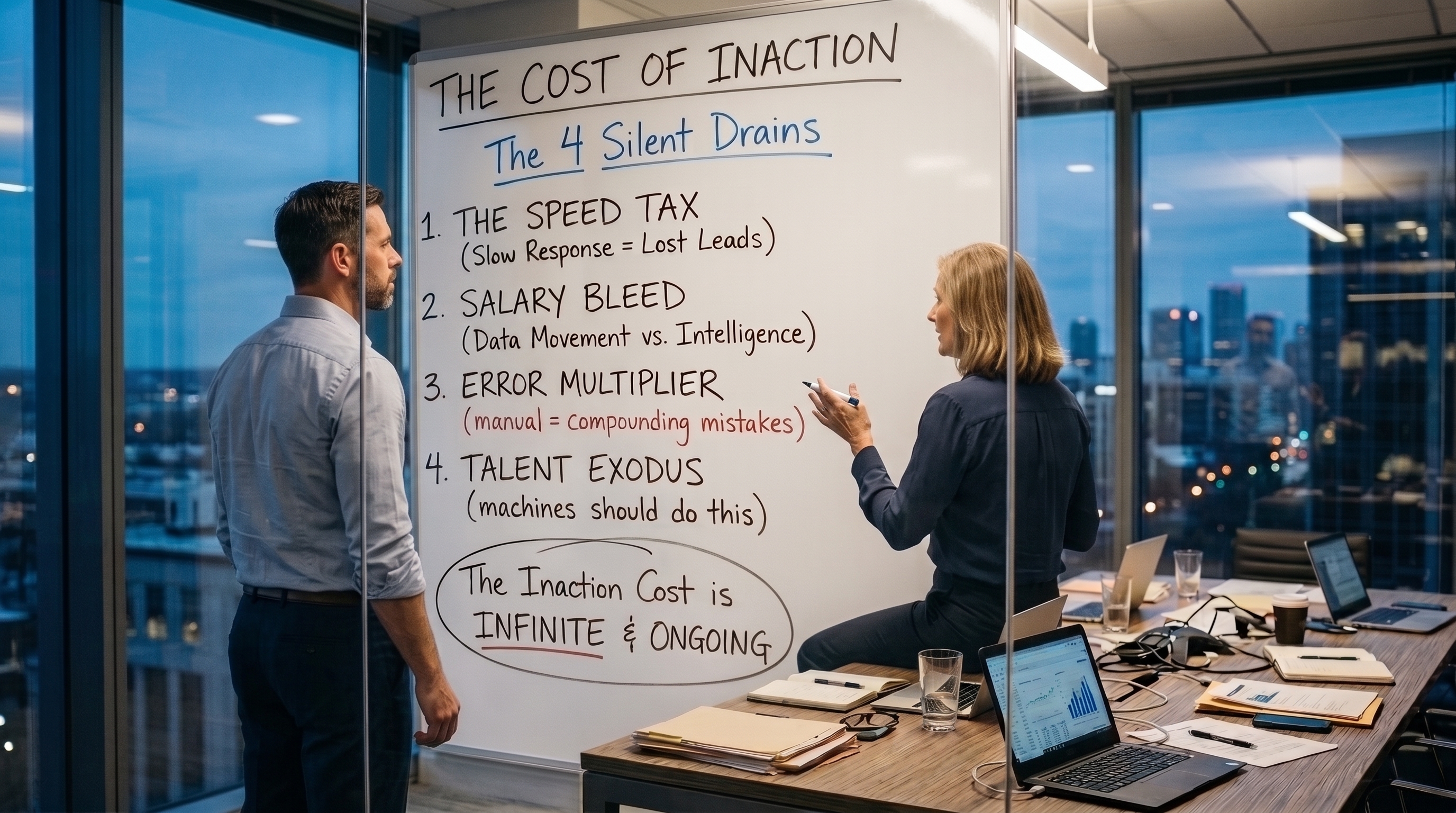
Every business has a number nobody talks about in board meetings. It's not on your P&L. It's not in your quarterly review. But it's there, every single day — the compounding cost of doing things manually that a system could handle in seconds. The businesses winning in 2026 aren't just the ones who automated early. They're the ones who stopped pretending that "we've always done it this way" is a strategy.
The Automation Conversation Nobody Is Having
When executives talk about automation, the conversation almost always goes one direction: ROI. How much will this save us? How long until payback? What's the implementation cost? These are reasonable questions. But they're the wrong starting point. The right question is: what is it costing us right now to not have this? That question is harder to answer — and far more uncomfortable. Because the cost of inaction is invisible until it isn't.
The Four Silent Drains
1. The Speed Tax
Every hour a lead sits uncontacted, conversion probability drops. Research consistently shows that responding to a lead within five minutes vs. thirty minutes results in a 21x difference in qualification rates. Most businesses are responding in hours — or days — because a human has to manually check an inbox, find the record, and type a reply. That gap is a speed tax you pay on every single lead, every single day. At 100 leads a month with a $3,000 average contract value, even a 10% improvement in conversion from faster response is $30,000 a month in recovered revenue. Not new revenue. Recovered.
2. The Salary Bleed
A mid-level operations manager in Nairobi costs KES 150,000–250,000 per month. A senior one in London costs £60,000–90,000 per year. A significant portion of that salary — in most companies, 40–60% of knowledge worker time — goes toward tasks that are fundamentally data movement: copying information from one system to another, reformatting reports, chasing approvals, sending status updates. You are paying human-intelligence wages for work that requires no intelligence at all. That's not a people problem. It's a systems problem.
3. The Error Multiplier
Manual processes don't just slow things down — they introduce errors that compound. A wrong figure in a financial model. A missed field in a client onboarding form. An invoice sent to the wrong entity. Each error has a direct cost (fixing it) and an indirect cost (the trust damage, the delay, the distraction from higher-value work). Studies on manual data entry show error rates between 1–5%. In a business processing 500 transactions a month, that's 5–25 errors every single month. Some are caught quickly. Some aren't caught until they're expensive.
4. The Talent Exodus
The best people in your organization — the ones with options — will not stay in a place that asks them to do work they know a machine should do. They didn't spend years developing expertise to copy-paste data between spreadsheets. The moment they find somewhere that respects their time and intelligence, they leave. And the people left behind are often the ones with fewer options, not fewer skills. Not automating isn't just a cost center problem. It's a talent strategy problem.
How to Calculate Your Real Inaction Cost
This is a back-of-napkin exercise that takes twenty minutes and is often more clarifying than a full automation audit.
- List your five most manual, repetitive processes across any department.
- For each, estimate how many hours per week it consumes across all staff involved.
- Multiply by the fully-loaded hourly cost of each person involved (salary + benefits + overhead).
- Add an estimate for error correction time — typically 15–20% of process time.
- Add a revenue impact estimate where relevant (delayed invoicing, slow lead response, missed follow-ups).
- Sum everything. Multiply by 52. That is your annual inaction cost.
Most leadership teams who do this exercise for the first time are stunned. Not because the individual numbers are large — but because they've been paying them, invisibly, for years.
The Compounding Problem
Here is what makes inaction particularly dangerous in 2026: your competitors are not standing still. The business across town — or across the world — that automated their lead response two years ago has now processed two years of customer data through that system. They've refined their sequences. They've learned which messages convert. Their system gets smarter every month. You're starting from zero. Automation advantages compound over time. The longer you wait, the larger the gap becomes. This isn't theoretical. It's arithmetic.
The cost of automating is finite and one-time. The cost of not automating is infinite and ongoing.
What to Do This Week
You don't need a transformation program. You need one honest conversation with your operations lead: "What is the most painful manual process in this business right now?" Then take that one process — just one — and price out what it would cost to automate it vs. what it is costing you to keep doing it manually. In almost every case, the math is not close. The ROI on automation is rarely the question. The real question is why it took this long to ask.
Key takeaway
The cost of not automating isn't a line item — it's a slow leak in everything. Revenue lost to slow follow-ups. Talent lost to soul-crushing repetitive work. Decisions delayed because someone is still building the report manually. You don't need to automate everything tomorrow. But you need to stop pretending the status quo is free. It isn't. It never was.
Written by
Muchiri Mwangi
I build AI automation and workflow systems for businesses, with a focus on practical results over hype.
More about meKeep reading
- Business Strategy
A 90-Day AI Automation Roadmap for an African SME (Without a Big Budget)
October 7, 2026 · 11 min read
- Business Strategy
Payment Is the Trigger: Automating Invoices, Receipts, and Reconciliation Around Mobile Money
September 21, 2026 · 10 min read
- Business Strategy
You Don't Have an AI Problem—You Have a Fear Problem. Here's How to Fix It.
July 25, 2026 · 12 min read