The Latest Frontiers in AI: Breakthroughs, Trends, and Practical Applications
Muchiri Mwangi
AI Automation Specialist
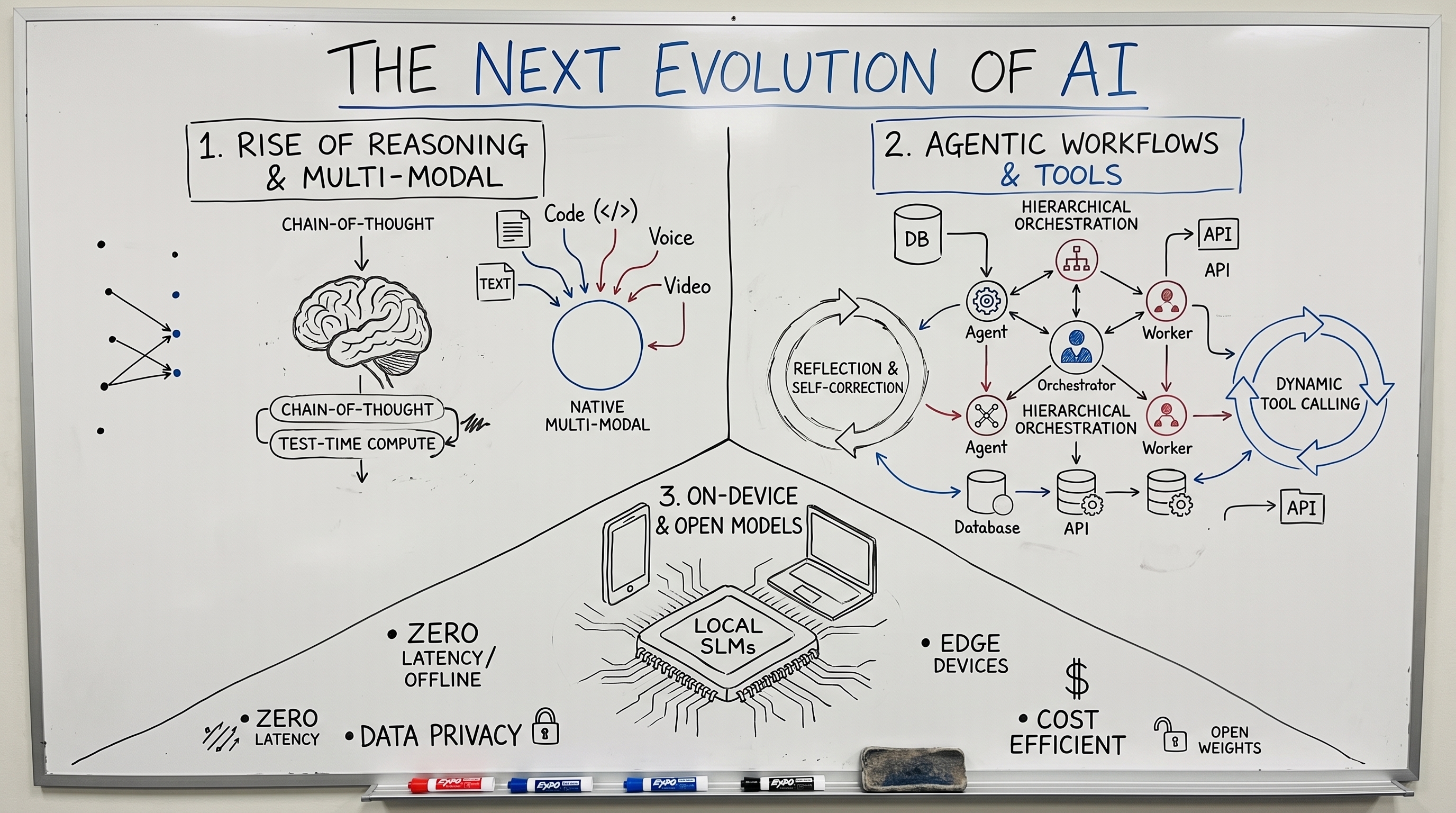
Artificial intelligence is evolving at a breakneck pace, transforming from a passive conversational tool into active, autonomous systems capable of complex reasoning and real-world execution. Keeping up with the deluge of new models, frameworks, and capabilities can feel overwhelming, but understanding these breakthroughs is essential for staying ahead in today's tech landscape.
1. The Rise of Reasoning and Multi-Modal Models
The frontier of AI research has shifted dramatically from purely increasing parameter counts to optimizing test-time compute and chain-of-thought reasoning. Modern foundation models no longer just generate the next likely token; they actively evaluate alternative hypotheses, double-check logic, and refine their conclusions before outputting a final answer.
Native Multi-Modality Beyond Text
Alongside reasoning advancements, multi-modal integration has become the baseline. Rather than relying on disparate vision or audio encoders appended to text models, state-of-the-art architectures natively process image, video, audio, and code inputs within a unified representation space.
2. Agentic Workflows and Tool Execution
Perhaps the most impactful practical shift is the migration from single-turn prompts to multi-agent automation patterns. Modern AI agents are equipped with function calling, state management, and memory systems that enable them to complete complex, asynchronous workflows.
- Dynamic Tool Calling: Interacting directly with REST APIs, databases, and file systems.
- Self-Correction and Reflection: Running code in sandbox environments, catching errors, and revising logic autonomously.
- Hierarchical Orchestration: Delegating sub-tasks across specialized worker agents.
The future of AI automation isn't just about faster text generation, it is about systems that can reliably act on your behalf across digital environments.
3. Efficient On-Device and Open Models
While massive cloud hosted models handle top-tier complex tasks, open-weights and heavily quantized small models (SLMs) are making high-performance AI available locally on consumer hardware, mobile devices, and edge nodes.
Key Benefits of On-Device AI
- Enhanced Data Privacy: Sensitive user data remains local without leaving the device.
- Zero Latency and Offline Capability: Immediate response times without network dependencies.
- Cost Efficiency: Eliminating per-token API fees for high-frequency low-complexity tasks.
Key takeaway
As artificial intelligence transitions from conversational assistants to proactive, agentic partners, the opportunities for automation and enhanced productivity are vast. By staying informed on the latest architectural trends and adopting practical integration patterns, developers and business leaders alike can turn modern AI breakthroughs into tangible competitive advantages.
Written by
Muchiri Mwangi
I build AI automation and workflow systems for businesses, with a focus on practical results over hype.
More about meKeep reading
- AI Automation
The Rise of ChatGPT Accountants: Which Jobs AI Is Quietly Taking Over Right Now
2026-11-20T18:06:01.798Z · 8 min read
- AI Automation
When AI Out-Codes Us: What Junior Developers Should Do Next
2026-11-16T12:39:11.983Z · 8 min read
- AI Automation
How to Find Leads and Close Them: The Volume Math Behind Hormozi and Other Top Sellers
2026-11-13T09:23:22.847Z · 8 min read