An AI Just Helped Solve a 60-Year-Old Math Problem. So Is It Still Just 'Artificial' Intelligence?
Muchiri Mwangi
AI Automation Specialist
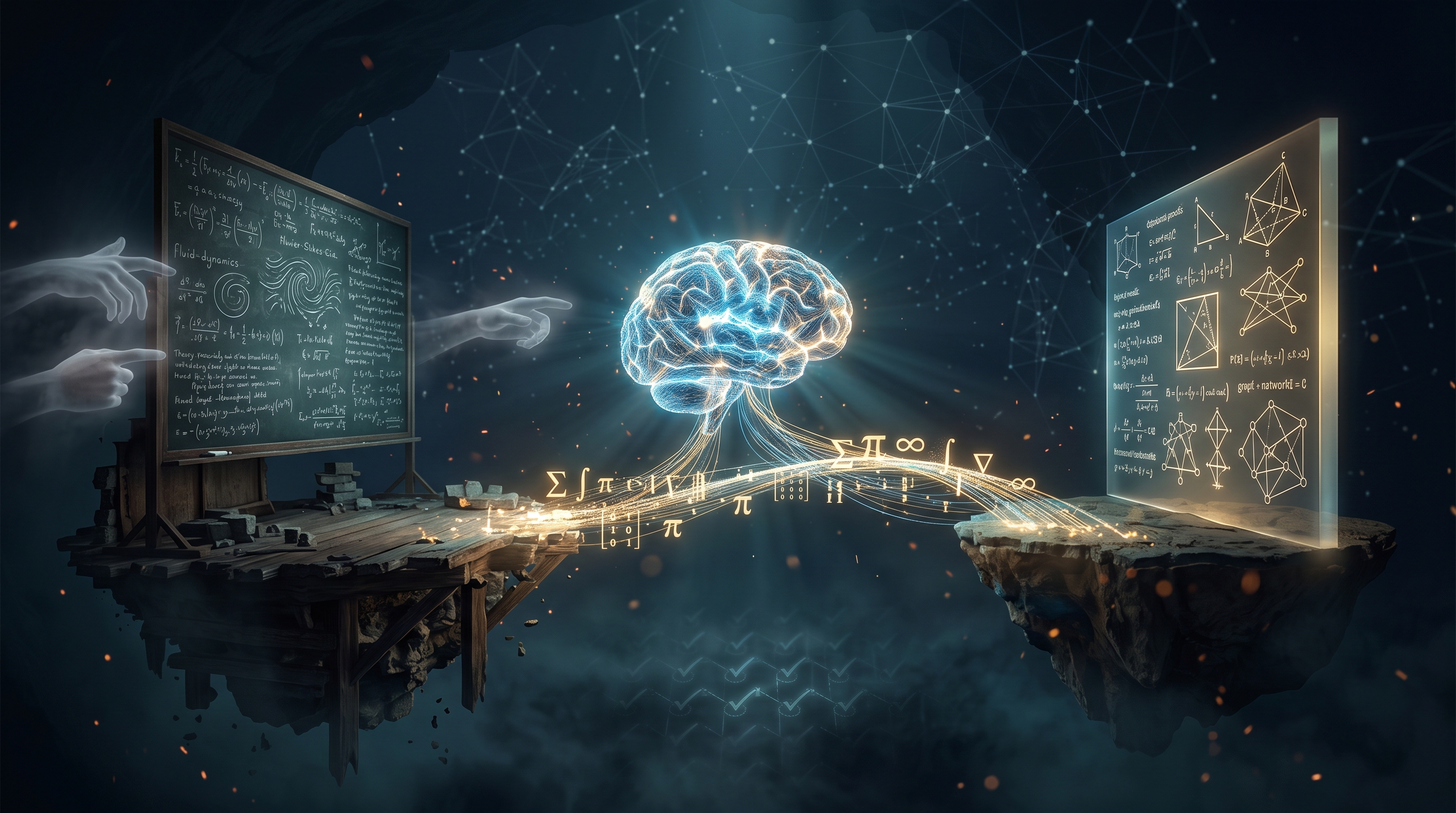
Imagine a puzzle that the smartest mathematicians in the world have been stuck on for over sixty years. Now imagine a computer program walking in, looking at it from a completely different angle, and finding a way through. That is exactly the kind of story that has people arguing online, in universities, and in research labs. In this post, I will explain what happened in plain language, how the AI did it, and why the debate about 'artificial' versus 'super' intelligence has suddenly become so loud.
What Kind of Problem Are We Talking About?
When most of us hear 'math problem', we think of the equations we solved in school, where you follow the steps and get an answer. The problems in this story are nothing like that. They are what mathematicians call open problems. These are questions that nobody in the world has been able to answer yet, and there is no step-by-step recipe to follow. To solve one, you often have to invent a brand-new way of thinking.
Many of these puzzles come from areas called combinatorics and number theory. In simple terms, that means studying how numbers and objects can be counted, arranged, and related to each other. A famous source of such puzzles is the Hungarian mathematician Paul Erdős, who spent his life posing hard questions and even offering small cash prizes for answers. Some of his questions have stayed unanswered for more than half a century.
There are also famously hard problems in physics, like the equations that describe how fluids such as water and air move. They are very difficult and still not fully understood. They show the same thing: some problems are hard enough that no one can simply follow a formula to the answer.
What Actually Happened?
Researchers gave advanced AI reasoning models some of these open problems. Instead of just guessing or crunching numbers, the AI did something that surprised many experts. It took an idea from a completely different branch of mathematics and used it to make progress on an Erdős problem that human specialists had not managed to crack for decades.
Think of it like this. Imagine a locked door that locksmiths have tried to open for sixty years using the tools of their trade. Then someone from a totally different profession, say a watchmaker, walks up and says, 'The mechanism in this lock works just like a part I use every day.' They use a tool nobody in the locksmith world thought to try, and the door opens. That is the kind of cross-over idea the AI brought to the table.
The AI did not just calculate faster. It brought a mathematical bridge that humans had not thought to build.
How Can an AI Spot Something Humans Missed?
To understand why this is possible, it helps to look at what makes humans and AI different when it comes to knowledge.
1. It Connects Ideas Across Many Fields
Mathematics is huge. It has dozens of specialist areas, and most mathematicians spend their whole careers going deep into just one or two. An AI model has been trained on a vast amount of written mathematics, so it can notice that a trick used in one area looks a lot like what is needed in another. A human expert could do the same thing, but only if they happened to have read the right paper in the right field at the right time.
2. It Thinks Longer Before Answering
Older AI tools gave instant answers. Newer reasoning models are different. They spend extra time working through a problem step by step, trying an idea, noticing when it fails, and trying another. This is a bit like a student who does not just write the first answer that comes to mind but checks their working, finds a mistake, and fixes it before handing in the paper.
3. It Works Together With Humans and Checking Tools
This part is very important and often gets lost in the headlines. These results did not come from an AI working completely alone. Human researchers chose the problems, pointed the AI in a direction, and judged whether the results made sense. In many cases, the proofs were also checked using special software, such as a system called Lean, which verifies line by line that a mathematical argument is correct. That matters because an AI can sound confident even when it is wrong, so checking is essential.
Here is a quick summary of what made this possible:
- Cross-field thinking: the AI linked ideas from different areas of mathematics that specialists rarely combine.
- Extra thinking time: the model tested ideas, caught its own errors, and improved its answers step by step.
- Human direction: researchers chose the problems and decided which results were worth following.
- Computer verification: proof-checking tools confirmed that the final arguments were actually correct.
The Big Question: Is It Still Just 'Artificial' Intelligence?
Here is where the debate gets heated. If a computer program can help solve a problem that stumped brilliant people for sixty years, should we still call it just 'artificial' intelligence? Or are we seeing the first small signs of what some people call Artificial Superintelligence, or ASI, meaning an intelligence that goes beyond the best human minds?
Smart, serious people disagree on this, so let us look at both sides fairly.
The Case for 'Artificial': Very Good Pattern Matching
Skeptics say the AI does not truly understand mathematics the way a person does. It has no real curiosity, no sudden flash of insight, no feeling of 'aha'. In their view, the AI produces a huge number of possible paths, and human mathematicians do the crucial job of recognizing which one is actually brilliant. They compare it to a very fast search engine for ideas rather than a thinker. By this argument, the credit for the discovery belongs largely to the people who guided and judged the work.
The Case for 'Super': Beyond What One Person Can Do
Optimists respond with a simple point. No single human being can hold every branch of mathematics in their head at once. There is simply too much of it. An AI can look across all of it together and spot hidden links that no individual would ever find. Even if it works differently from a human mind, the result is something no single human mind can match: knowledge combined across an entire field. For these people, that already looks like a new kind of intelligence.
So Where Does the Truth Sit?
Both sides have a point, and the truth is probably in the middle. The AI is clearly doing something more than simple calculation. But it is also not a lone genius working without help. It needs people to ask the right questions, to judge what is worth pursuing, and to check that the answers are correct. A fair way to see it is as a very powerful partner rather than a replacement.
It is also worth being careful with big headlines. Stories about AI breakthroughs often sound bigger than the details really are, so it is always smart to ask who checked the result, what exactly was solved, and how much of the work was done by humans.
Why Should You Care, Even If You Are Not a Mathematician?
You might be thinking that this is interesting but has nothing to do with your daily life. In fact, it connects to something very practical. The same skills that helped an AI find a bridge between two areas of mathematics are the skills that make AI useful in business: spotting patterns in messy data, connecting information from different places, testing many options quickly, and improving its answer after finding its own mistakes.
- In finance, AI can help test risk models and spot patterns across huge amounts of data.
- In business automation, it can connect tools, reports, and workflows that used to be handled by hand.
- In research and education, it can help people explore ideas faster and learn from more sources than ever before.
- In every field, human judgment is still needed to ask the right questions and check the results.
The people who will benefit most from AI are not the ones who trust it blindly, but the ones who learn how to work with it and check its work.
Key takeaway
So, is it artificial intelligence or superintelligence? Right now, the honest answer is that it sits somewhere in between. AI is not a conscious mathematician with a sudden flash of genius, and it is also no longer just a fancy calculator. It is a powerful new tool that can connect ideas across the whole of human knowledge faster than any one person could. The best results so far come from humans and AI working together: people bring the questions, the judgment, and the checking, and AI brings the speed, the memory, and the unexpected links. If you work in automation, finance, data, or any field built on logic, the lesson is simple. Do not fear this shift, and do not blindly trust it either. Learn how to work with these tools, check their work, and use them to go further than you could alone.
Written by
Muchiri Mwangi
I build AI automation and workflow systems for businesses, with a focus on practical results over hype.
More about meKeep reading
- AI Automation
The Rise of ChatGPT Accountants: Which Jobs AI Is Quietly Taking Over Right Now
2026-11-20T18:06:01.798Z · 8 min read
- AI Automation
When AI Out-Codes Us: What Junior Developers Should Do Next
2026-11-16T12:39:11.983Z · 8 min read
- AI Automation
How to Find Leads and Close Them: The Volume Math Behind Hormozi and Other Top Sellers
2026-11-13T09:23:22.847Z · 8 min read