AI Agents Per Company Just Tripled: Inside the Data on Enterprise Agent Adoption
Muchiri Mwangi
AI Automation Specialist
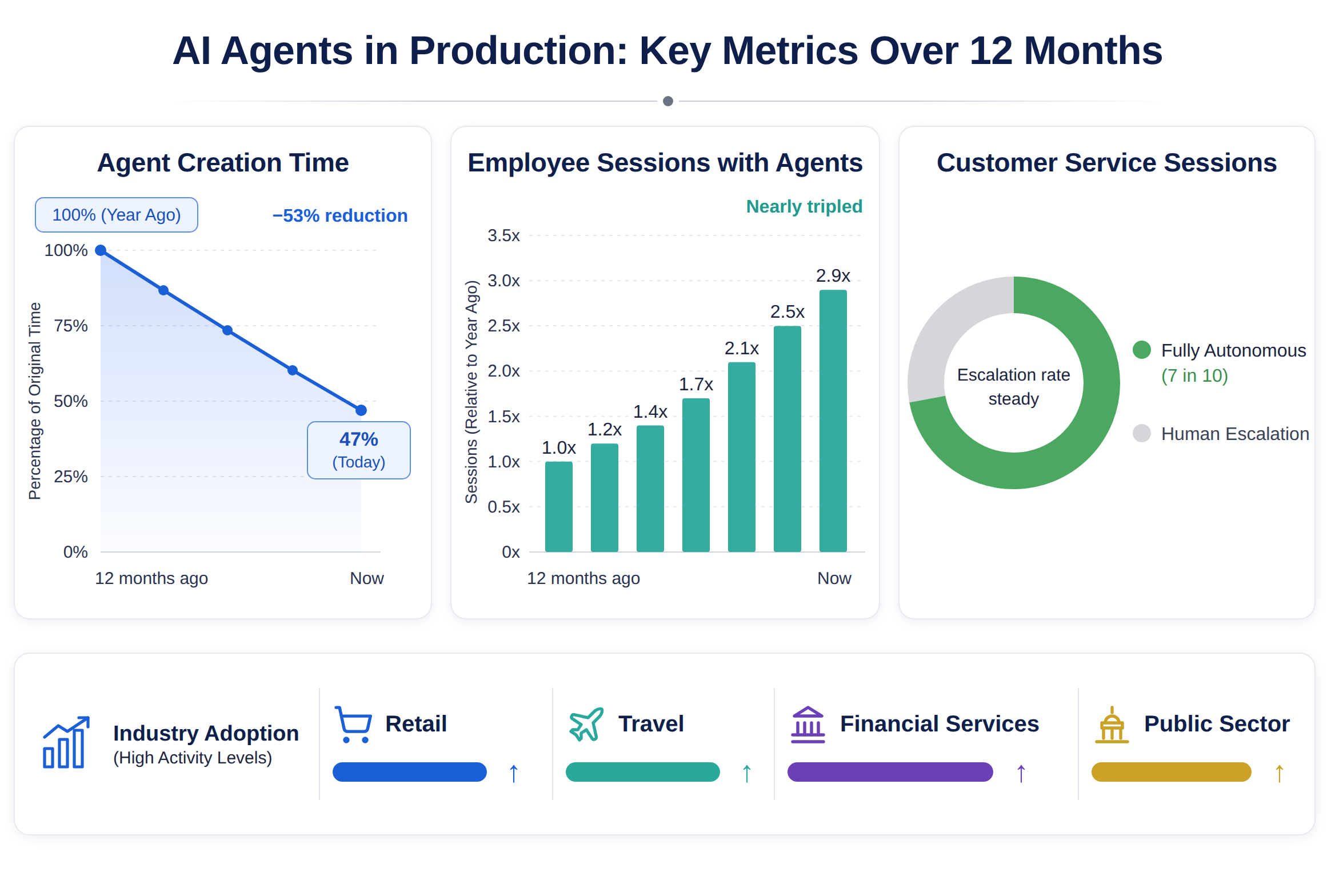
For years, "AI agents" has been a term surrounded more by demos and predictions than by hard numbers. That changed with the release of new production-usage data tracking AI agent deployment across hundreds of businesses. The headline figure: the average number of AI agents deployed per organization has nearly tripled, from five in early 2025 to thirteen by April 2026. This isn't a survey of intentions. It's a measurement of what's actually running in production, and it tells a very different story than the one dominating LinkedIn.
The Numbers Behind the Headline
The data comes from an analysis of production activity across 400 businesses, combined with a survey of nearly 5,000 people. It found that agent creation time fell 53% over the past year, meaning it now takes roughly half as long to stand up a working agent as it did twelve months ago. Employee sessions with agents nearly tripled, and, critically, agents are increasingly handling complex, multi-step work that spans multiple internal systems rather than single, isolated tasks.
The Customer Service Number That Should Worry You
Perhaps the most striking figure: seven in ten customer-service sessions are now handled entirely autonomously among the businesses in this dataset, with escalation rates to human agents remaining steady rather than climbing. That means the shift to autonomous handling isn't coming at the cost of quality, it's happening alongside stable escalation, which suggests these systems are actually working, not just deflecting.
Where Adoption Is Concentrated
Retail, travel, financial services, and the public sector all showed the sharpest increases in agent activity. Regulated industries, somewhat counterintuitively, tended to deploy more sophisticated systems rather than fewer, likely because the compliance and audit-trail requirements of regulated work push teams toward building more capable, better-documented agent architectures from the start.
- Retail: inventory forecasting, personalized offers, and returns processing running with minimal human review
- Travel: rebooking, itinerary changes, and customer communication during disruptions
- Financial services: fraud flagging, document processing, and compliance-adjacent reporting
- Public sector: case triage and citizen-facing information services
Why This Matters More Than Another AI Trend Piece
The distinction between "piloting AI agents" and "running thirteen of them in production" is enormous, and it's the difference most competitive analysis misses. A pilot doesn't change your cost structure. Thirteen production agents handling real customer volume does. If your business is still running one or two narrow automations while your competitors are operating a fleet of agents across departments, the operational gap between you is already showing up in your customers' experience, whether you can see it internally or not.
Agent creation time falling by half in a single year means the barrier to deploying your next agent isn't technical anymore, it's organizational.
What "Multi-Step, Cross-System" Actually Means in Practice
Early agent deployments tended to be narrow: answer a question, look up an order status, draft a reply. The shift this data captures is toward agents that coordinate across systems, pulling from a CRM, checking inventory, updating a ticketing system, and triggering a follow-up, all within a single customer interaction. That's a meaningfully harder engineering problem than a single-purpose chatbot, and the fact that adoption is moving in this direction signals that the underlying tooling for orchestration has matured enough to make it practical for mainstream businesses, not just AI-native companies.
The Practical Takeaway
If your organization is at "five agents or fewer," you're not behind the curve, you're at roughly where the average business was over a year ago. That's not necessarily alarming on its own, but it is a signal to move deliberately rather than to keep treating agent deployment as an experiment. Pick the process generating the most customer friction right now, and build toward autonomous handling with a clear escalation path. The businesses in this dataset that succeeded weren't chasing novelty, they were systematically converting friction points into agent-handled workflows, one at a time.
Key takeaway
The story in this data isn't that AI agents are coming, it's that they've arrived, and the businesses further along the curve are pulling ahead quietly, in production, without much fanfare. Thirteen agents per organization sounds abstract until you realize it means your competitors have likely automated customer service, lead routing, and internal reporting to a degree you haven't. The gap isn't closing. It's widening every quarter this data gets updated.
Written by
Muchiri Mwangi
I build AI automation and workflow systems for businesses, with a focus on practical results over hype.
More about meKeep reading
- AI Agents
The Next Frontier Speaks Swahili: Voice AI for Customers Who Would Rather Talk Than Type
September 28, 2026 · 10 min read
- AI Agents
The AI Board Member Is Already Sitting in Your Competitor’s Boardroom
July 23, 2026 · 14 min read
- AI Agents
AI Agents Are Quietly Running 40% of Fortune 500 Operations Right Now (And Nobody Noticed)
July 20, 2026 · 14 min read